

Time flies. This update is long overdue.
Quick recap:
Slick helps trucking and logistics companies save thousands of dollars monthly by cutting unnecessary execution costs.
We provide real-time visibility into how transport orders are performing against the plan, allowing us to identify and resolve issues for our clients the moment they occur.
Where are we now?
Our first customer started paying in Q1 of last year. By Q4 we crossed $100K ARR.
More than 1K people are using Slick weekly.
In my last post I wrote that 200K messages were sent via Slick to date - now almost twice as much is sent monthly.
Slick is already handling fleets much larger than 100 trucks for many of our customers.
We tried 6 different channels to acquire customers. We found the one that works - 90% of the customers were acquired in a repeated manner.
The team is still small. Founders, 2 amazing engineers and a 2 person sales team.
Around a year ago we raised a seed round of financing from SMOK Ventures and a group of angel investors.
Our next big goal is hitting 1 million ARR. We’ve done that before at Base so I really don’t see a reason why this time should be different :)
Honestly, it feels like our biggest challenge right now is to execute at scale on what already works.
Speaking of execution - we’re looking for great people to help us in two key areas:
Product - If you’re (or know) an ambitious, customer-oriented developer who loves shipping stuff to production, please contact me at bart@slickshift.ai or apply here
Sales - If you’re (or know) someone with a proven track record selling B2B software, ideally in the transportation/logistics space - please also contact me at bart@slickshift.ai or apply here
There are a few topics I’d like to cover in more depth this time:
Funding
Product
Sales & customer acquisition
Funding
As I shared in my previous post, we bootstrapped the business at the start. MVP came out in early 2024. First customers started using the product pretty quickly. Back then I wrote about Slick for the first time, that was Q1 ‘24.
Honestly, the main reason for those early posts was recruitment. But something unexpected happened: a few VCs reached out.
At that point we weren’t even thinking about raising. Cash was fine, costs low, we were still experimenting a lot.
What caught their eye? Strong team (most of us ex-Base with an exit), huge unsexy market, and the fact that we had actually shipped an MVP.
We chatted with a couple of VCs, but since we weren’t raising money, things cooled off fast. Still, the seed was planted. External capital started feeling like a real option.
After a while we realized: to build a truly compelling product, we needed to grow the product team. Our revenue was zero back then, so the choices were simple: provide more of our own money, or take external investment. We did both.
To get on VCs’ radar properly, I decided to write the second post about Slick. It focused on three things: real customer progress (validation), why our team rocks, and how we planned to grow.
Right after the post went live, Borys from SMOK Ventures messaged me: “You inspired me to record a TikTok ;) https://vm.tiktok.com/ZGetJgwvX/”.
I’d met Borys before and shared our story. That TikTok showed he really listened – and he thinks about building businesses in a similar way we do. With that, it became pretty clear that there is a real opportunity to start working together.
We set up a full day with the SMOK team in Kraków. Borys and Diana came over, we locked ourselves in a room. A few days later we had a high-level handshake agreement!
With SMOK leading it was much easier to close angel investors: Bartek Majewski, Richard Lucas, Krzysiek Langer and the Base crew – Uzi, Agata, Sebastian. We knew almost everyone already, so closing was smooth.
How’s it been working with SMOK so far?
Super natural, direct, and friendly process
Borys really means it when he says he doesn’t want to waste founders’ time. It’s true both during and after the round
They’re quick to help with intros, job postings to their portfolio, etc.
Very transparent about everything – evaluation, terms, legal. Most of it is even on their website
The money lets us grow the team and go after customers seriously. And that is exactly what we’re doing.
Product
Where should I even start with this one? As a reminder, here’s how I described what we built last time:
“Slickshift is where technology meets logistics, creating a smoother, more productive world. We’re making logistics communication effortless and putting visibility into freight and driver locations at everyone’s fingertips. Our goal is to revolutionise communication in logistics just as Slack transformed communication within companies.”
People don’t buy “smoother experience” or “effortless communication.”
What they actually buy is real value for their business.
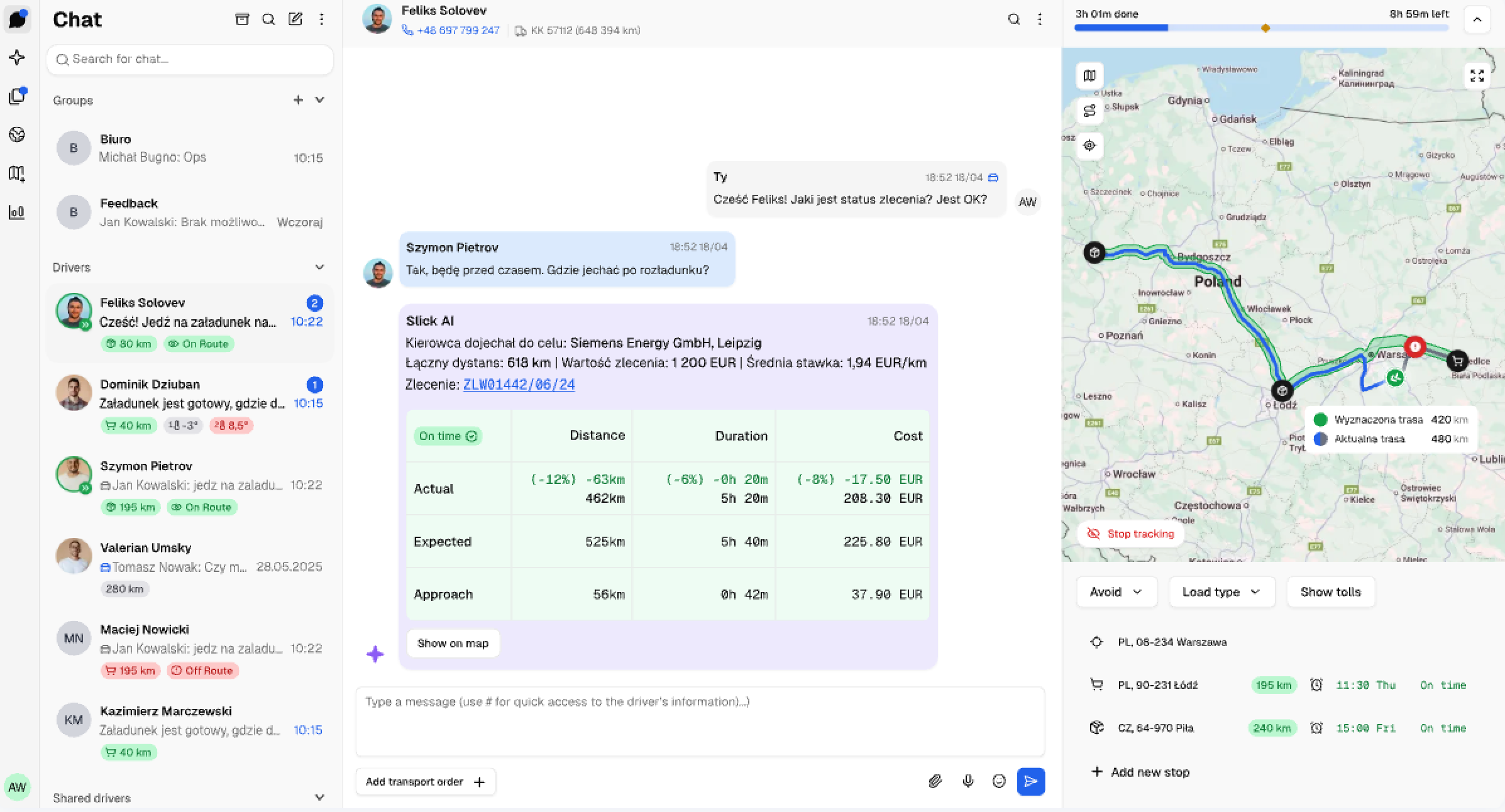
That’s why, with Slick, trucking companies save money by catching and eliminating expensive mistakes during transport orders.
A typical truck drives 10-12K kilometers per month. If the fleet consists of 50 trucks, that is 500K-600K km monthly. Assuming that 1-2% of that can be eliminated (sometimes it’s more), we’re talking about north of ~10K unnecessary km saved, which may mean tens of thousands of dollars saved monthly.
How do we do it? We focus mainly on 3 things:
We enable the choice of the best route considering drivers’ working time, route length, and road costs.
We eliminate extra kilometers driven by the fleet due to driver mistakes (e.g. deviating from the route, taking the wrong border crossing, driving on the highway instead of a cheaper road).
After every transport we immediately provide a comparison of the delivery plan vs actual execution. All differences are visible right away. This way we can eliminate similar mistakes in the future.
That value proposition is what starts conversations with trucking company owners.
And yes - we still make communication effortless, we use AI a lot (actually most of the things above happens automatically), we connect to GPSes, we replace chunks of forwarders’ duties.
But the goal of all of it is simple: saving money for trucking companies.
My single biggest shift in how I think about building product now (which might be obvious to some, but definitely wasn’t the norm for me):
The person who builds the product should also be the one selling it.
Doesn’t matter if they love it or hate it, if they’re good at it or not - all product work must be validated first with potential leads. In the early stage, you only have so many existing customers. The main goal is growth, so making sure what you build actually makes sense for future customers is by far the most important thing. It’s also the reality check on how delusional product people can be.
Moving forward our main ambition in product is this:
Let Slick take over more and more of the manual work that dispatchers and forwarders still do today.
There are many repetitive tasks with every transport order and we believe we can automate them completely thanks to the progress in technology that has happened recently . It’s similar to what happened in support: many cases get resolved by agents or AI with zero human touch. The same thing is starting in sales. We think that similar stuff will happen in managing drivers and transport. That’s our core focus at the moment.
Sales & customer acquisition
That’s the area where we’ve made the biggest progress and I’ve learned the most over the course of last year. I will dedicate a separate post to share more on that.
To wrap it up - at the beginning of last year we had very little idea how to speak about Slick’s value, via what channels to reach customers and how to make this process repeatable.
We closed last year having acquired all revenue in a repeatable manner via only one sales channel. Onwards!
As I wrote before, our next big goal is hitting 1 million ARR. We’re looking for engineers and sales people who would like to help us with that. Please drop me a line if you know someone (bart@slickshift.ai).